IA 첨삭 패키지
ToK 첨삭 패키지
커리큘럼
자주묻는질문
인재채용
Mentoring Program Curriculum (1)
/
Subjects
/
Economics
/
Topics
/
4. The Global Economy
수학
영어
화학
생물
경제
전시회 Exhibition
에세이 Essay
일회성 첨삭
방학특강
정규반
Mentoring Program Curriculum (1)
/
Subjects
/
Economics
/
Topics
/
4. The Global Economy
IA 첨삭 패키지
수학
영어
화학
생물
경제
ToK 첨삭 패키지
전시회 Exhibition
에세이 Essay
일회성 첨삭
커리큘럼
방학특강
정규반
자주묻는질문
인재채용
4. The Global Economy
Tags
Gallery view
Search
International trade:
exchange of goods and services between countries.
•
Mechanism:
It involves both exports (selling domestically produced goods and services to foreign markets) and imports (buying goods and services produced in foreign markets).
•
Freedom:
International trade is considered "free" when there is no government intervention such as quotas, tariffs, or other restrictions imposed to reduce or limit trade.
Benefits of free trade
The benefits of free trade can be seen for a country where the world price for a good/service is above the domestic price thus allowing for exports
To consumers
•
Lower prices
•
Greater choice
4.1 Benefits of international trade
Trade protection:
policies by a country to reduce imports from other countries and/or increase exports.
Tariffs
Tariff:
tax imposed on an imported good.
•
Increases the cost of the imported good → decreases demand for the imported good.
•
Domestic producers
•
Domestic consumers
4.2 Types of trade protection
Arguments in favour of protection
Infant industry argument
Infant industry:
a
new domestic industry that has not yet established itself to compete with more ‘mature’ foreign rivals.
•
Infant firms have a higher unit cost than existing firms (since they gain fewer economies of scale), thus they are higher up on the LRAS curve. Thus, an infant industry might struggle to compete with a mature industry.
•
If an infant industry is protected from foreign competitors,competition then it will be able to grow, gain economies of scale, and be able to compete with foreign rivals.
Evaluation
•
It’s difficult for the government to identify which industries have the potential to grow and compete in global markets.
•
Protection can disincentivise infant industries to operate efficiently (since they are provided with production subsidies already) which disables them to compete internationally.
4.3 Arguments for and against trade control and protection
Economic integration:
economic interdependence between countries is usually achieved by agreement between countries to reduce or eliminate trade barriers between them.
Preferential trade agreements
•
Preferential trade agreements:
the agreement between 2 or more counties to lower trade barriers between them on particular products.
•
Bilateral trade agreement: the agreement to lower trade barriers between 2 trading partners.
•
Regional trade agreement: the agreement to lower trade barriers between countries within a region.
•
Multilateral trade agreement: the agreement to lower trade barriers between many countries.
Trading blocs
•
Free trade area (FTA):
members of the trading bloc agree to free trade between themselves.
4.4 Economic integration
Exchange rate:
the value of one currency expressed in terms of another currency.
Exchange rate systems
•
Free floating exchange rate system: the
value of a currency is determined by market forces.
•
Fixed exchange rate system:
exchange rate set by the government and is maintained through appropriate central bank intervention.
•
Managed exchange rate system:
exchange rate is allowed to float but there is periodic intervention by the central bank
Evaluating free floating exchange rate system
Appreciation, depreciation, revaluation, devaluation
4.5 Exchange rates
Balance of payments:
the record of all financial transactions between one country and the rest of the world in one year.
Accounting in BoP
•
Credits (+): Money flowing into an account.
•
Debits (-): Money flowing out of an account.
•
Surplus: More money flows in than out.
•
Deficit: More money flows out than in.
The Current Account
•
The Current Account is often considered to be the most important account in the BoP
4.6 Balance of payments
Sustainable development
Sustainable development:
development involving the use of resources in the present to meet present needs and wants in ways that do not deplete or degrade them, so that future generations will have enough resources to meet their own needs.
Sustainable development goals
Sustainable development goals:
17 goals developed by the United Nations in 2012
•
Measure progress towards poverty reduction and sustainable development.
1. No poverty
2. Zero hunger
3. Good health and well-being
4.7 Sustainable development
Single indicators
GDP / GNI per capita at purchasing power parity (PPP)
PPP exchange rates are used to resolve the issue of different countries having different purchasing powers of the same amount of money.
•
Eliminate the effect of differing price levels.
Health indicators
•
Infant mortality rate: number of deaths before age 1 per 1,000 live births.
•
Maternal mortality rate: number of women who die per year as a result of pregnancy-related related causes, per 100,000 births.
Composite indicators
4.8 Measuring development
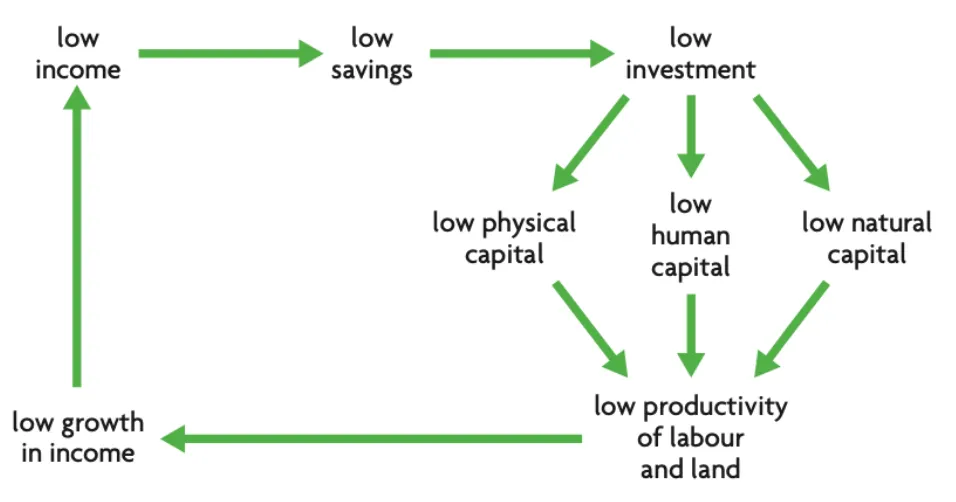
Poverty cycle / trap
Poverty cycle / trap:
circular chain trapping individuals / societies in poverty.
Fig 4.9.1 The poverty cycle
Economic barriers
Rising income inequality
Decrease in access to education, healthcare, and nutrition → decreases the ability of the country to develop.
•
Higher income inequality → disincentivise workers → lower productive efficiency → lower production → misallocation of resources.
•
Higher income inequality → higher relative poverty → lower access to quality education → lower access to future jobs = barrier to development.
4.9 Barriers to economic growth and / or economic development
Trade strategies
Import substitution industrialisation (ISI)
Import substitution industrialisation (ISI):
a strategy to reduce imports using protectionism to allow domestic industry to grow.
Export led growth
Outward looking growth strategy based on increased international trade.
Growth achieved by focusing on exports and increasing export revenue → increase AD.
4.10 Economic growth and / or economic development strategies