IA 첨삭 패키지
ToK 첨삭 패키지
커리큘럼
자주묻는질문
인재채용
Mentoring Program Curriculum (1)
/
Subjects
/
Physics
/
Topics
/
B. The particulate nature of matter
수학
영어
화학
생물
경제
전시회 Exhibition
에세이 Essay
일회성 첨삭
방학특강
정규반
Mentoring Program Curriculum (1)
/
Subjects
/
Physics
/
Topics
/
B. The particulate nature of matter
IA 첨삭 패키지
수학
영어
화학
생물
경제
ToK 첨삭 패키지
전시회 Exhibition
에세이 Essay
일회성 첨삭
커리큘럼
방학특강
정규반
자주묻는질문
인재채용
B.
The particulate nature of matter
Created
2024/06/24 03:17
Tags
갤러리 보기
Search
B.1.1 Molecular theory of solids, liquids and gases
Understanding: Properties of the three states of matter considered in physics
Particle Model of Matter:
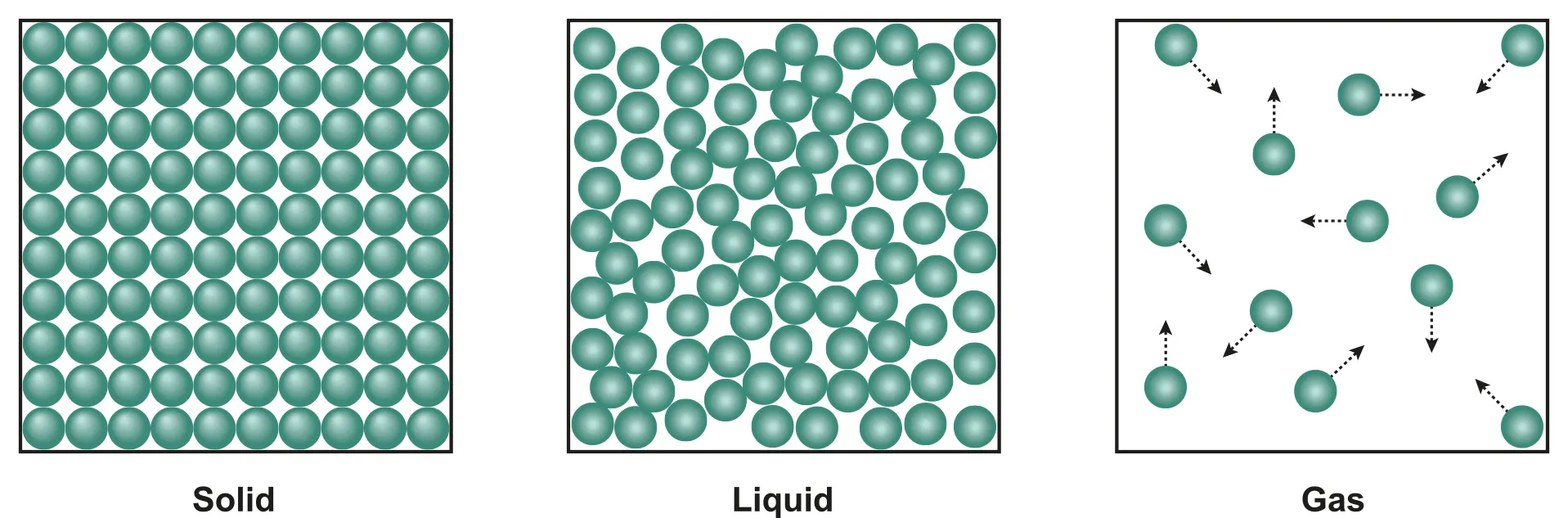
B.1.1-1 Diagram of 3 main states
•
Model that attempts to explain the properties of the three states of matter
Properties of a Solid:
•
Atoms are fixed in place by a strong force (or bond) between each other. → Strong intermolecular force between atoms (fixed structure)
•
This force prevents the atoms from separating and keeps the volume and shape constant
•
Greater distances → attractive force (energy released during bond formation), shorter distances → repulsive force
•
The attractive intermolecular force between the atoms in the solid means energy is required to move atoms away from each other and energy is released when the atoms move closer
•
Lowest potential energy
B.1 Thermal Energy Transfer
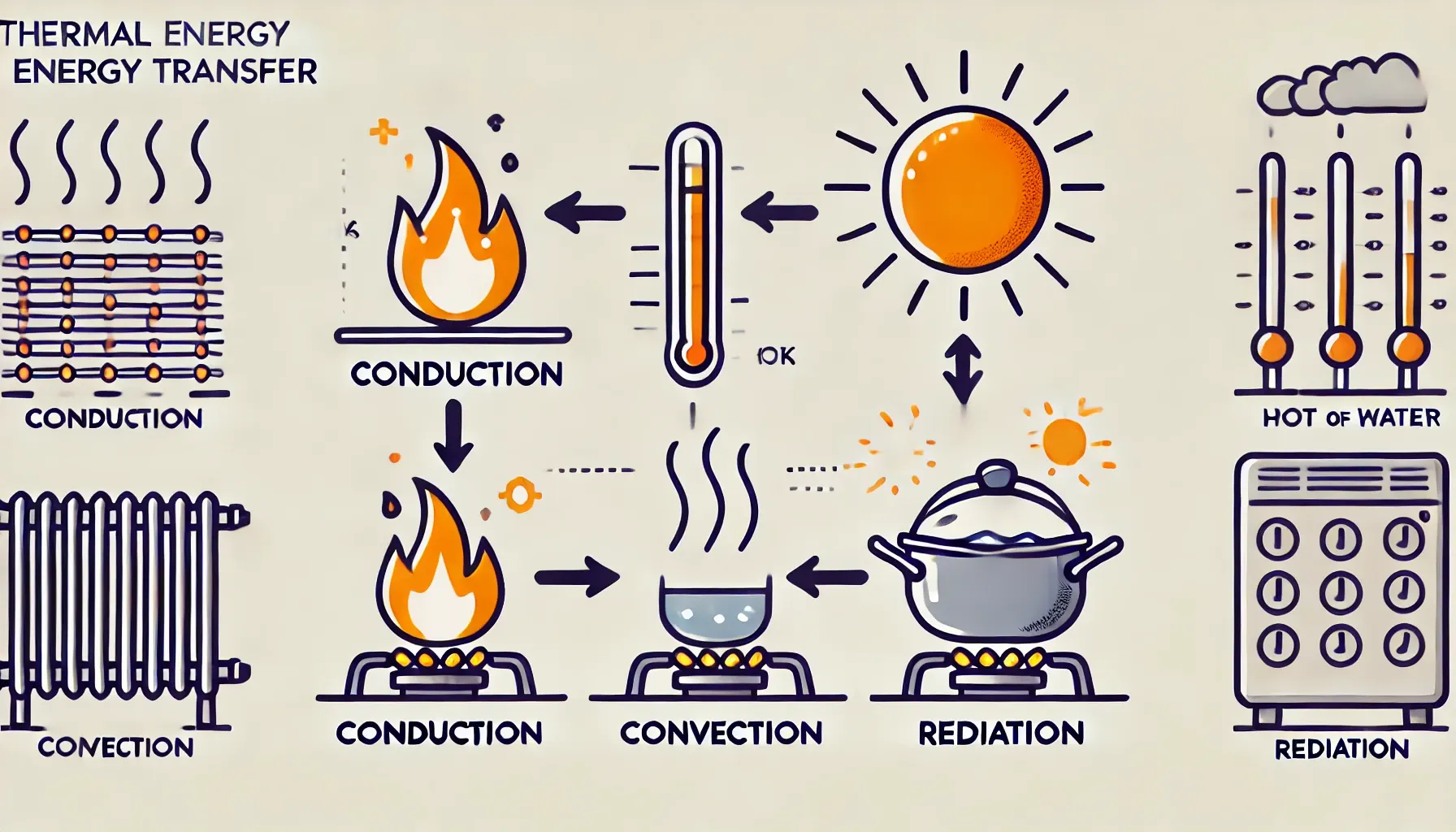
B.2.1 Conduction, convection, and thermal radiation
Conduction, Convection and Thermal Radiation
Conduction
•
Conduction
is when
energy is transferred by direct contact
•
Usually happens in solid
•
When two solids in different temperatures contact conduction happens
•
Metal
are good thermal conductors because :
•
Non-metal
are poor thermal conductors because :
Convection
•
Convection
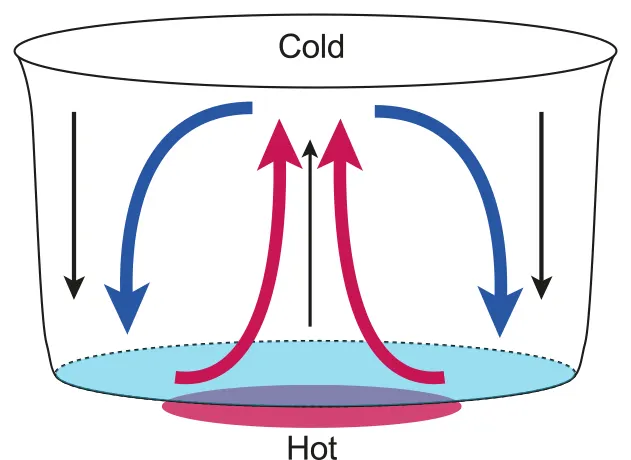
is when energy is transferred by the mass motion of molecules
•
Mainly happens in liquids and gases
•
When a liquid is heated convection happens
B.2.1-2 Diagram showing the convection
Radiation
B.2 Greenhouse Effect
B.3.1 Avogadro constant, Pressure, and Gas Laws
Molar Concept Rules
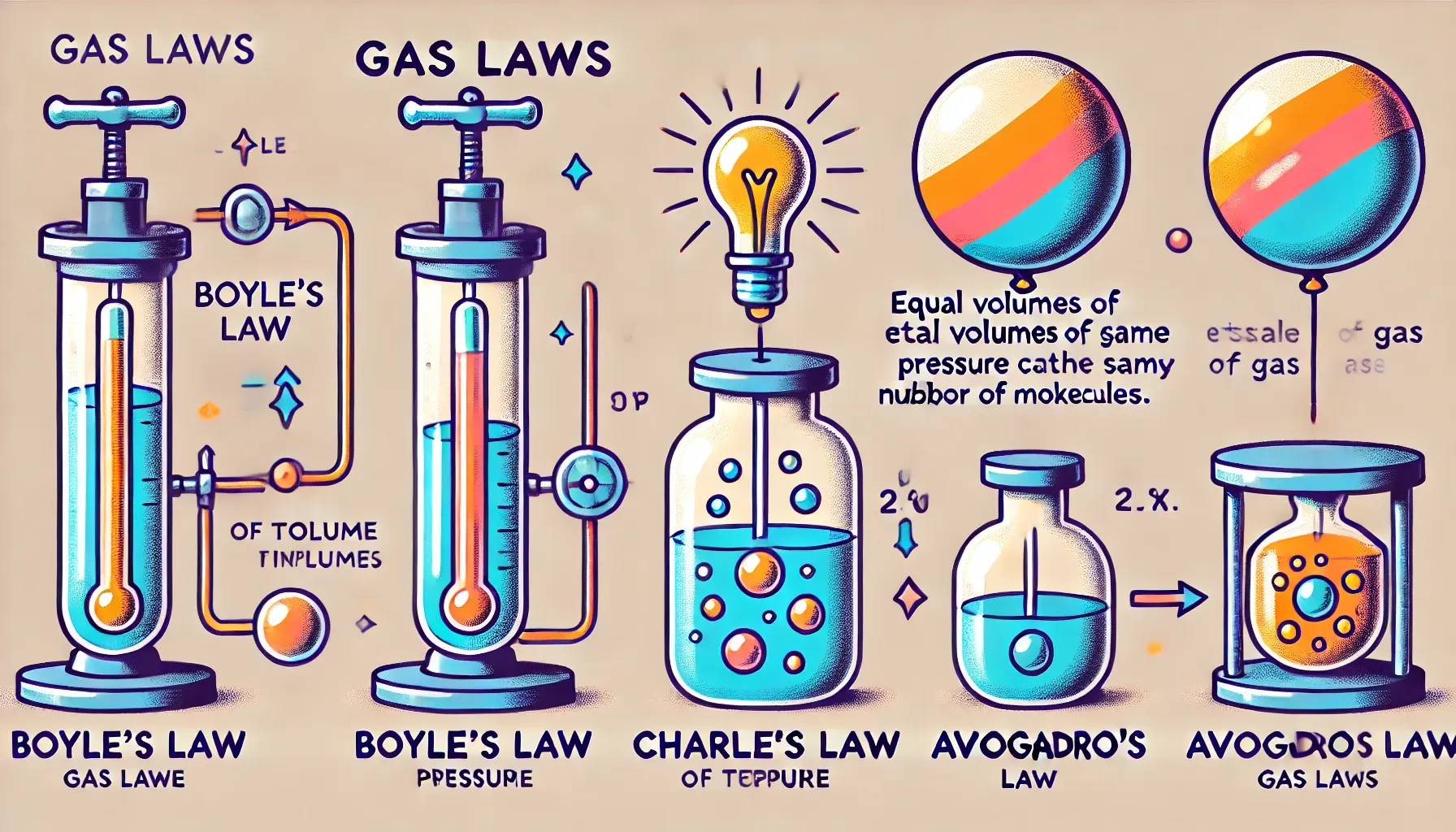
Gas Laws
•
Boyle’s Law : Pressure of a gas of fixed mass and at a constant temperature is inversely proportional to its volume
•
This means that the product of
p
and
V
is always constant
p
1
V
1
=
p
2
V
2
=
constant
p_1 V_1 = p_2 V_2 = \textit{constant}
p
1
V
1
=
p
2
V
2
=
constant
•
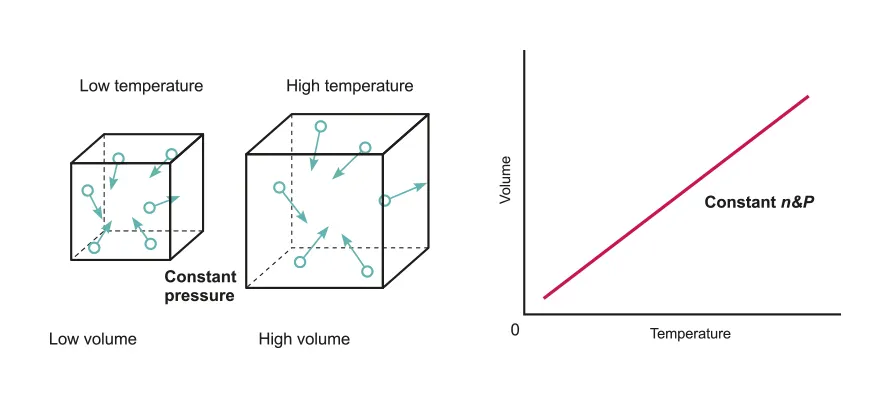
Charles’s Law
: Volume of a gas of fixed mass and constant pressure is directly proportional to its temperature
V
∝
T
V ∝ T
V
∝
T
•
Which means
V
divided by
T
is always constant
V
1
T
1
=
V
2
T
2
,
V
1
T
2
=
V
2
T
1
=
constant
\frac{V_1}{T_1} = \frac{V_2}{T_2}, \quad V_1 T_2 = V_2 T_1 = \textit{constant}
T
1
V
1
=
T
2
V
2
,
V
1
T
2
=
V
2
T
1
=
constant
B.3.1-2 Diagram of particles at low temperature and high temperature and graph representing relationship between volume and temperature
•
Gay Lussac’s Law : Pressure of a gas of fixed mass and volume is directly proportional to its temperature
p
∝
T
p \propto T
p
∝
T
B.3 Gas Laws
B.4.1 Basic Definitions
Internal Energy
Types of Systems
•
Closed system
•
Isolated system
Sign Convention
•
Clausius’ sign convention
B.4.1 First Law of Thermodynamics
First Law of Thermodynamics
Work Done by a Closed System
Change in Internal Energy
B.4 Thermodynamics
B.5.1 Ohm's Law
Mathematical Approach of Ohm’s Law
•
As mentioned previously, whenever there is a potential difference there must be an electric field
•
When a potential difference is established at the ends of a conductor, an electric field is established within the conductor that forces electrons to move and create the current
•
The size of the current is different in the different conductors, as each conductor will operate with different efficiency
•
The properties of the conductors to resist the current flow is called electric resistance
•
The equation of resistance is :
R
=
V
I
R=\frac VI
R
=
I
V
B.5.1-1 Equations explaining Ohm’s Law with notations
B.5.1-1 Equations explaining Ohm’s Law with notations
•
This relationship, we called it ohm’s law, and the unit is ohm, symbol
•
Materials that obey ohm’s law have a constant resistance in any circumstances
•
For those ohmic materials, a graph of I versus V gives a straight line through the origin
B.5.1-2 Graph of current against voltage in ohmic materials
B.5 Current and Circuits